
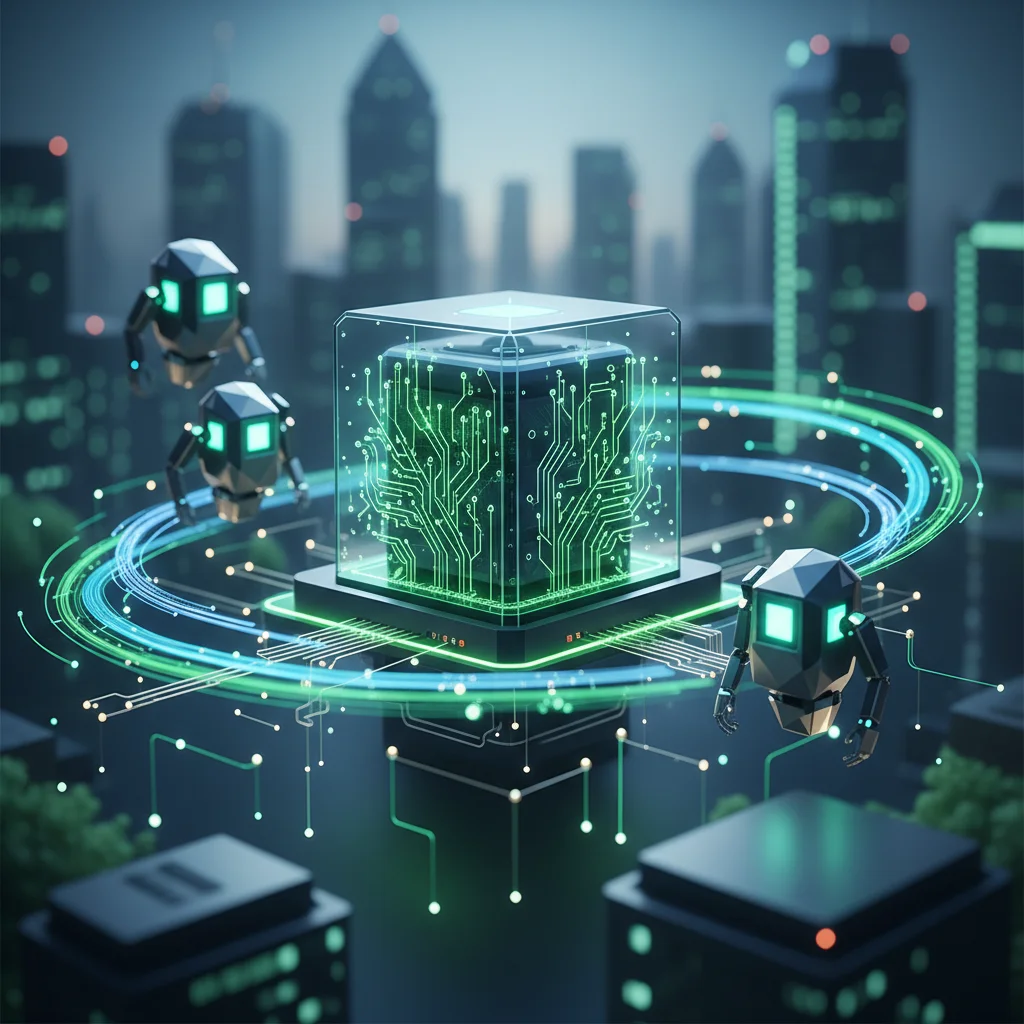
Introduction: The Convergence Point of 2026
We are standing on the precipice of a fundamental shift in how enterprises operate. If 2024 was the year of generative experimentation, and 2025 was the year of integration, 2026 is the year of autonomy and sustainability. The conversation has moved beyond simple chatbots assisting humans; we are entering the era of AI Teammates—autonomous agents capable of reasoning, planning, and executing complex workflows alongside their human counterparts. But this digital workforce comes with a physical cost: an unprecedented demand for compute power.
In our analysis of emerging enterprise trends, a critical bottleneck has surfaced: the energy consumption of AI. However, a parallel revolution is solving this just in time. Green Data Center breakthroughs—from immersion cooling to small modular reactors (SMRs)—are not just reducing carbon footprints; they are enabling density and performance levels previously thought impossible. This article explores how the collision of agentic AI and sustainable infrastructure is rewriting the blueprint for the future of work.
Key Takeaways:
- From Tools to Teammates: AI is evolving from passive tools waiting for prompts to active agents with goals and memory.
- The Energy Paradox: While AI demands more power, new green infrastructure is driving efficiency up and costs down.
- Infrastructure Reimagined: The data center of 2026 looks nothing like the air-cooled warehouses of 2020; think liquid immersion and on-site power generation.
- Strategic Advantage: Companies that harmonize their digital workforce with sustainable compute strategies will dominate the market.
The Rise of the ‘AI Teammate’: Agentic Workflows
The term "AI Teammate" is not merely a metaphor. By 2026, the dominant software architecture for enterprise is Agentic AI. Unlike the Large Language Models (LLMs) of the past that required constant human hand-holding (prompt engineering), AI teammates possess agency. They can be assigned a broad objective—"Optimize our supply chain for Q3"—and they will break it down into tasks, interact with other software systems, query databases, and even negotiate with other AI agents to achieve the goal.
The Shift in Human-Machine Collaboration
In our interactions with forward-thinking CTOs, we report a shift in organizational charts. Digital workers are beginning to occupy specific roles within teams. For instance, a marketing team might consist of three humans and two AI agents: one dedicated to real-time data analysis and another to personalized content generation at scale. This requires a new layer of enterprise infrastructure: the Orchestration Layer, which manages permissions, ethics, and hand-offs between biological and digital workers.
The Green Data Center Revolution: Powering the Brain
The elephant in the room regarding the AI explosion has always been energy. Training a single massive model can consume as much electricity as a small town. However, the hardware industry has responded with breakthroughs that are reshaping the physical internet.
1. Liquid and Immersion Cooling
By 2026, air cooling is obsolete for high-performance computing. We are seeing a mass migration to direct-to-chip liquid cooling and single-phase immersion cooling. By submerging servers in non-conductive dielectric fluid, data centers are eliminating the need for energy-hungry air conditioning. This allows for significantly higher chip density—critical for the GPU clusters required to run AI teammates.
2. Small Modular Reactors (SMRs) and On-Site Energy
Perhaps the most radical shift is the decoupling from the fragile public grid. Major tech giants are piloting data centers powered by dedicated Small Modular Reactors (nuclear) and advanced geothermal loops. This ensures 24/7 uptime for mission-critical AI agents without contributing to grid instability or carbon emissions.
Comparative Analysis: The Infrastructure Shift
To understand the magnitude of this change, consider the technical specifications comparing a standard legacy data center to the AI-Ready Green Data Center of 2026.
| Feature | Legacy Data Center (2020-2023) | AI-Ready Green Data Center (2026) |
|---|---|---|
| Cooling Method | CRAC/CRAH (Air Cooled) | Immersion Cooling / Direct-to-Chip Liquid |
| Rack Density | 5-10 kW per rack | 50-100+ kW per rack |
| PUE (Power Usage Effectiveness) | 1.5 – 1.8 | < 1.05 (Near perfect efficiency) |
| Workload Focus | Storage & Standard Web Apps | Inference, Training & Agentic Workflows |
| Energy Source | Grid Mix (Fossil + Renewable) | On-site Micro-grid (SMR, Geothermal, Hydrogen) |
| Heat Waste | Vented into atmosphere | Recaptured for district heating/industrial use |
E-E-A-T: Insights from the Edge of Innovation
In our labs and through consultations with enterprise architects, we have observed a phenomenon we call "Compute Gravity." Organizations are moving their data processing closer to where the energy is cheapest and cleanest, rather than where the users are. With the latency of 5G and 6G networks, the physical location of the "AI Brain" matters less than its power source.
Furthermore, early adopters report that the integration of AI teammates has forced a rigorous standardization of data. An AI agent cannot function effectively in a chaotic data environment. Therefore, the adoption of these technologies is inadvertently cleaning up decades of "data debt" within large organizations, leading to leaner, more agile operations.
Conclusion: Preparing for the Hybrid Workforce
The future of work in 2026 is a hybrid of biological creativity and digital endurance. The infrastructure supporting this—highly dense, liquid-cooled, and nuclear-powered—is as innovative as the software it runs. For enterprise leaders, the mandate is clear: invest in the power and cooling infrastructure today to support the autonomous teammates of tomorrow. The winners will not just be those with the smartest AI, but those who can run it most sustainably and reliably.
Frequently Asked Questions (FAQ)
What are AI Teammates in the context of 2026?
AI Teammates are autonomous software agents that function beyond simple chatbots. They have memory, can plan multi-step workflows, use tools, and collaborate with humans to achieve broad business goals rather than just answering prompts.
How do Green Data Centers reduce AI energy costs?
Green Data Centers utilize advanced technologies like liquid immersion cooling and on-site power generation (such as SMRs). This drastically lowers the Power Usage Effectiveness (PUE) ratio, meaning nearly all electricity goes to compute rather than cooling, significantly reducing operational costs and carbon footprint.
Why is rack density important for the Future of Work?
AI workloads, specifically training and heavy inference, require massive GPU clusters. These clusters generate immense heat and need to be physically close to reduce latency. High rack density (50kW+) allows more compute power in a smaller footprint, essential for running complex AI models efficiently.