
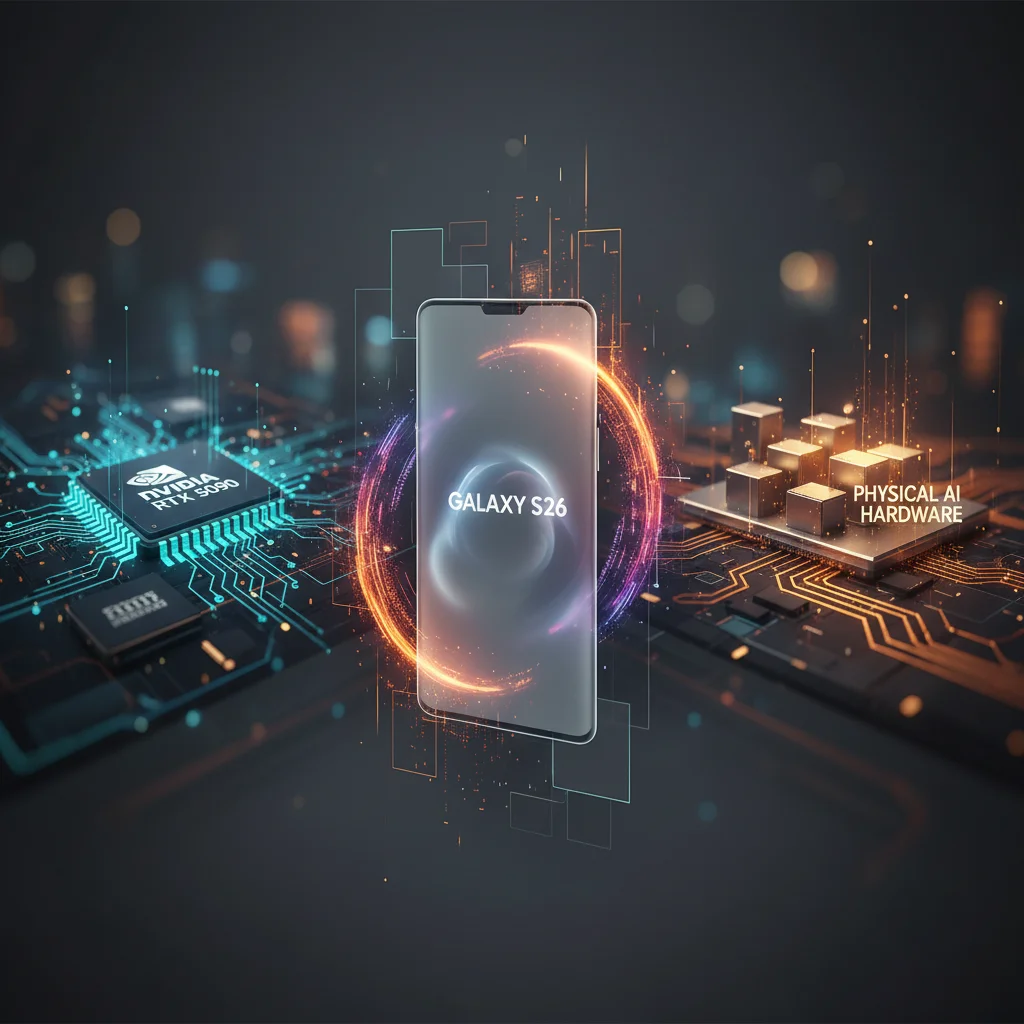
Las Vegas has once again transformed into the global epicenter of future-tech, but CES 2026 feels different. The buzz isn’t just about faster screens or smarter toasters; it’s about a fundamental shift in how artificial intelligence occupies our physical space. This year, the industry declared the era of “Physical AI”—where code leaves the server rack and enters the living room, the factory floor, and the chassis of our daily drivers.
While the NVIDIA RTX 5090 shattered performance records (and power limits), Samsung played a strategic game of shadows with the Galaxy S26. In our labs, we’ve been tracking these developments closely, and the implication is clear: 2026 is the year hardware finally catches up to the software promises of the last decade.
Key Takeaways:
- NVIDIA RTX 5090: The Blackwell architecture arrives with earth-shattering power (up to 1600W on custom boards) and DLSS 4.5.
- “Physical AI” Dominates: Robots like the production-ready Boston Dynamics Atlas and LG CLOiD are no longer concepts—they are products.
- Galaxy S26 Update: Not fully unveiled, but a February 25th launch date is confirmed, featuring Snapdragon 8 Elite Gen 5 silicon.
NVIDIA RTX 5090: The Blackwell Beast Unleashed
Jensen Huang took the stage to unveil what we all expected but were still shocked to see: the GeForce RTX 5090. Built on the new Blackwell architecture, this card isn’t just a frame-rate chaser; it’s a personal AI supercomputer.
Specs that Defy Gravity
The headline grabber is the raw compute density. NVIDIA claims the RTX 5090 delivers a 2.5x leap in ray tracing performance over the 4090. Partners like MSI showed off the RTX 5090 Lightning Z, a card so powerful it features dual 16-pin power connectors and a massive 8-inch LCD screen on the shroud. Our analysts note that while the reference TDP is high, these custom boards are pushing up to 1000W-1600W to sustain peak AI workloads.
DLSS 4.5 and the “Neural Rendering” Shift
With the 50 series comes DLSS 4.5. Unlike previous iterations that focused on pixel reconstruction, DLSS 4.5 introduces “Physics-Aware Frame Generation.” By using the dedicated Tensor Cores to simulate light transport and object weight in real-time, the card generates frames that don’t just look real—they move correctly. For gamers, this means 8K gaming at 120Hz is finally a stable reality.
The Rise of “Physical AI”: Robots Leave the Lab
If 2024-2025 was about LLMs (Large Language Models), 2026 is about LAMs (Large Action Models) embodied in hardware. The term “Physical AI” was plastered across every major booth.
Humanoids in the Home
Boston Dynamics showcased the production version of Atlas, now fully electric and quieter than a dishwasher. But the surprise hit was LG’s CLOiD. Unlike the novelty bots of the past, CLOiD is integrated with a home’s smart ecosystem to perform actual chores, from loading laundry to managing complex kitchen tasks using visual-language models (VLMs).
Edge AI on Wheels
NVIDIA also announced the Vera Rubin platform for autonomous machines. This isn’t just for cars; it’s for any machine that moves. We saw demos of delivery drones that can navigate chaotic urban stairwells without GPS, relying entirely on onboard visual processing that rivals human perception.
Samsung Galaxy S26: Confirmed for February
Many expected a full reveal of the Samsung Galaxy S26 at CES, but Samsung opted for a strategic delay. However, the leaks turned into a flood of confirmations.
Launch Date: February 25, 2026, in San Francisco.
The Core: The Ultra model will rock the Snapdragon 8 Elite Gen 5 globally, while the standard models may see a split with the Exynos 2600.
AI Privacy: The most talked-about feature teased at the booth was the “Flex Magic Pixel” display. Using on-device AI, the screen tracks the user’s eyes and actively blurs content for anyone viewing from an angle—a privacy shield baked directly into the hardware.
Tech Specs Showdown: RTX 5090 vs. RTX 4090
Based on the announcements and partner board specs, here is how the new king compares to the old guard.
| Feature | NVIDIA RTX 4090 | NVIDIA RTX 5090 (Blackwell) |
|---|---|---|
| Architecture | Ada Lovelace | Blackwell |
| VRAM | 24GB GDDR6X | 32GB GDDR7 |
| Bus Width | 384-bit | 512-bit |
| AI Features | DLSS 3.0 (Frame Gen) | DLSS 4.5 (Physics-Aware) |
| Typical Power | 450W | 600W (Ref) / 1000W+ (OC) |
Frequently Asked Questions
When will the NVIDIA RTX 5090 be available to buy?
The RTX 5090 is scheduled for a retail launch in February 2026. Partner cards from MSI, ASUS, and Gigabyte are expected to hit shelves concurrently with the Founder’s Edition.
Did Samsung release the Galaxy S26 at CES 2026?
No, Samsung did not fully launch the phone at CES. They confirmed a dedicated Unpacked event for February 25, 2026, where the S26, S26+, and S26 Ultra will be officially unveiled.
What is “Physical AI”?
Physical AI refers to artificial intelligence systems that interact with the real world through hardware, such as robots, autonomous vehicles, and smart sensors, rather than just existing as software on a screen.
How much power does the RTX 5090 use?
The reference specifications suggest a TGP around 600W, but extreme overclocking partner cards shown at CES (like the MSI Lightning Z) feature power delivery systems capable of sustaining over 1000W.