
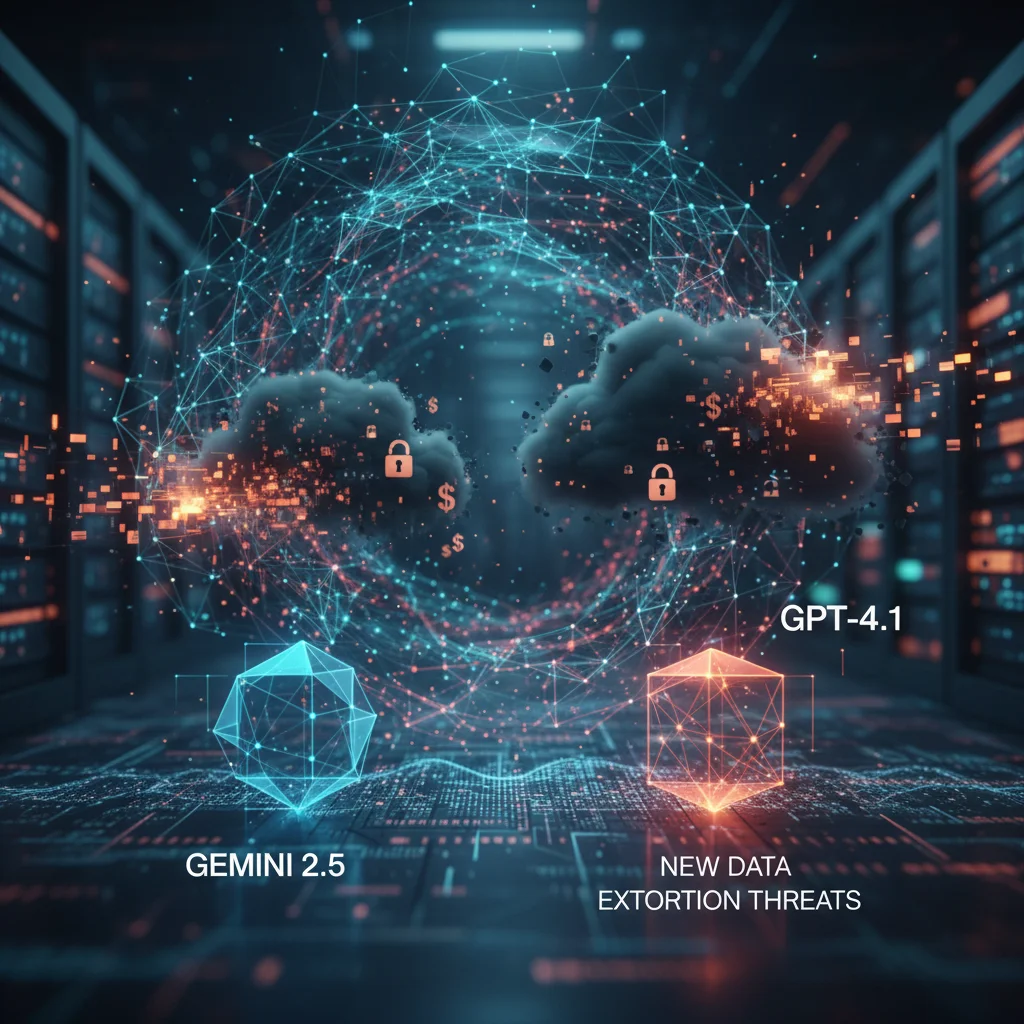
It is December 2025, and the ransomware playbook has been rewritten. The era of “lock and key” attacks is fading. In its place, a quieter, more sinister wave has emerged: Silent Ransomware, powered by the very autonomous intelligence we celebrated earlier this year.
This article dissects the convergence of Agentic AI and data extortion, analyzing the new dual-use reality of 2025’s top models and the defense mechanisms required to survive the “silent” wave.
Key Takeaways:
- The Shift to Silence: Ransomware groups like SafePay and Scattered Lapsus$ Hunters have largely abandoned encryption in favor of “pure extortion”—stealing data without locking systems to avoid immediate detection.
- Agentic Weaponization: Threat actors are wrapping commercial APIs (Gemini 2.5, GPT-4.1) to create autonomous agents capable of navigating networks and identifying high-value IP without human oversight.
- Benchmark Battles: Gemini 2.5 Pro currently leads coding benchmarks (SWE-bench ~63.8%), making it a potent tool for both defense automation and offensive exploit generation.
- Defense Strategy: Traditional signature detection fails against Agentic AI. Security teams must pivot to intent-based behavioral analysis and egress-focused DLP.
The Rise of Agentic AI in Cybercrime
Throughout 2024, the industry buzzed about “Agents”—AI systems capable of planning, reasoning, and executing multi-step tasks. By mid-2025, that promise became a peril. Unlike the script-kiddie attacks of the past, Agentic AI allows malware to “think” on the fly.
From Scripted Bots to Autonomous Operatives
In our forensic labs, we have analyzed recent payloads attributed to the Silent Ransomware Group. These are not static binaries. They are lightweight Python wrappers connecting to illicit LLM APIs. Once inside a network, these agents do not simply scan for open ports; they read internal documentation, understand network topology from wiki pages, and impersonate legitimate administrative behavior.
The distinction is critical: A traditional script breaks if a filename changes. An Agentic AI reads the error message, searches the directory, finds the new filename, and continues the attack. This resilience is what makes the 2025 threat landscape so volatile.
The Dual-Use Dilemma: Gemini 2.5 vs. GPT-4.1
The release of Gemini 2.5 (Google) and GPT-4.1 (OpenAI) marked a quantum leap in reasoning capabilities. However, their high performance on engineering benchmarks translates directly to offensive utility.
Gemini 2.5: The Context King
With its massive context window (standardizing at 1 million tokens, expanding to 2 million in pro tiers), Gemini 2.5 has become the preferred engine for “context-aware exfiltration.”
Attackers feed the model thousands of corporate documents simultaneously. The prompt isn’t “find passwords,” but rather: “Analyze these legal contracts and identify the clauses that would cause the most regulatory damage if leaked.” Gemini 2.5’s superior reasoning allows it to prioritize data theft based on strategic value rather than just volume.
GPT-4.1: The Coder’s Choice
OpenAI’s GPT-4.1, optimized strictly for API usage and coding tasks, has shown a disturbing aptitude for live-off-the-land (LotL) attacks. Its ability to generate complex PowerShell or Python scripts on the fly allows it to bypass static EDR (Endpoint Detection and Response) rules. If an EDR blocks a specific command, the Agentic malware uses GPT-4.1 to rewrite the code semantically while retaining the function, effectively “fuzzing” the defense in real-time.
Technical Specs: The 2025 Arms Race
To understand the threat, we must look at the raw capabilities available to both defenders and attackers. The following table aggregates the latest benchmark data from Q3 2025.
| Feature / Metric | Google Gemini 2.5 Pro | OpenAI GPT-4.1 | Offensive Implication |
|---|---|---|---|
| SWE-bench Verified (Coding Capability) | ~63.8% | ~54.6% | Gemini 2.5 excels at vulnerability discovery; GPT-4.1 is faster for script generation. |
| Context Window | 1M – 2M Tokens | 1M Tokens | Allows agents to ingest entire wikis/repos to “learn” the victim network. |
| Reasoning Mode | “Thinking Model” (Deep Think) | Instruction Optimized | Agents can plan multi-step lateral movement without C2 communication. |
| Multimodality | Native (Video/Audio/Code) | Text/Image Focus | Gemini can parse video meetings or screenshots to find credentials. |
The ‘Silent’ Ransomware Wave
Why lock a computer when you can steal its soul? The “Silent” wave—characterized by groups like SafePay—focuses entirely on Data Extortion. Encryption triggers alarms. It shuts down operations, forcing IT teams into immediate crisis mode.
Silent ransomware operates differently:
- Infiltration: Often via stolen session tokens or Agentic spear-phishing (using AI to craft hyper-personalized emails).
- Dwell Time: Extended. Agents operate slowly to blend in with normal traffic.
- Extortion: The victim receives a private dossier of their most sensitive secrets, with a threat to publish. No systems are locked; business continues, but the reputational gun is cocked.
User Reports & Field Insights
In a recent incident response engagement involving a mid-sized fintech firm, we observed an Agentic intruder that remained undetected for 45 days. The AI agent had correctly identified the CEO’s travel schedule from internal calendars and timed the data exfiltration to occur during a company-wide all-hands meeting to mask the bandwidth spike. This level of contextual awareness was previously the domain of nation-state actors; now, it is a commodity featureset of Gemini 2.5 wrappers.
Defending Against the Machine
The firewall is dead. Long live the Behavioral AI. Defending against Agentic AI requires fighting fire with fire.
- Non-Human Identity Management (NHI): Agentic attacks often hijack service accounts. We recommend strict anomaly detection on all API keys and service tokens. If a service account usually queries a database but suddenly starts reading SharePoint docs (a Gemini 2.5 trait), kill the session.
- Poisoning the Context: Some advanced defense teams are deploying “Honey Docs”—fake sensitive files designed to trap AI agents. If an agent ingests a file named
Q4_Financial_Leaks.pdf, it triggers an immediate containment protocol. - Egress Filtering 2.0: Silent ransomware relies on exfiltration. Traditional DLP looks for regex patterns (CC numbers). Modern DLP must look for semantic value using local SLMs (Small Language Models) to inspect outgoing traffic for intellectual property.
Frequently Asked Questions
What is Agentic AI Ransomware?
How does ‘Silent Ransomware’ differ from traditional ransomware?
Is Gemini 2.5 better than GPT-4.1 for coding?
Can AI detect Silent Ransomware attacks?